What’s Trending in South Africa’s Petroleum Industry Right Now
South Africa’s petroleum industry is currently dominated by one major topic: expected fuel price relief in July 2026.
After months of pressure from high petrol and diesel prices, early fuel price data suggests that motorists and businesses may finally see meaningful decreases at the pumps. Diesel users, in particular, are expected to benefit from some of the biggest potential decreases.
However, there is a major catch. The temporary fuel levy relief that helped reduce the impact of recent fuel increases is expected to end from 1 July 2026. This means the final price drop may be smaller than the early recovery numbers suggest.
For businesses that depend on diesel, petrol, illuminating paraffin, LP Gas and other petroleum products, the message is clear: fuel may become cheaper in July, but the market remains uncertain.
1. Fuel Prices Are Expected to Drop in July 2026
The biggest petroleum story right now is the expected drop in fuel prices.
Current mid-month data points to possible decreases in:
- Petrol 93
- Petrol 95
- Diesel 0.05% sulphur
- Diesel 0.005% sulphur
- Illuminating paraffin
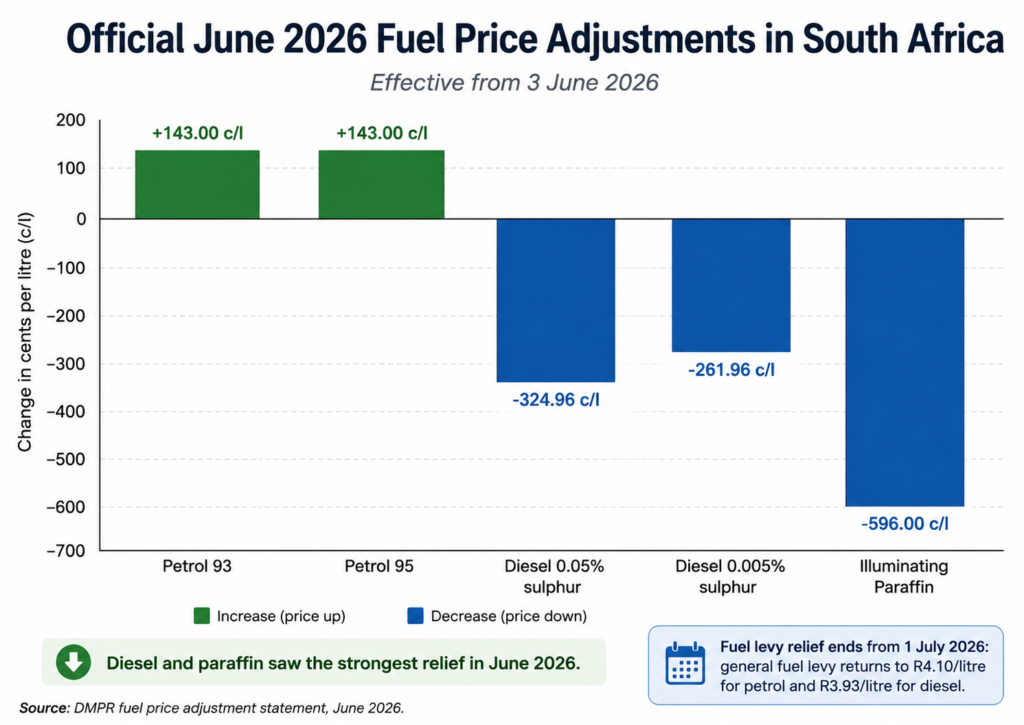
Diesel is showing the strongest potential relief, which is important for businesses in logistics, construction, agriculture, mining, plant hire and manufacturing.
A diesel price decrease can help reduce operating pressure because diesel affects far more than transport. It impacts delivery costs, generator costs, machinery costs, farming input costs and tender pricing.
2. Diesel Users Could See the Biggest Relief
Diesel is currently the product receiving the most attention.
This matters because many South African businesses rely on diesel every day. Trucks, generators, mining equipment, construction machinery, tractors and delivery fleets all depend on reliable diesel supply.
For businesses buying fuel in bulk, even a small price decrease per litre can make a major difference. A decrease of a few rand per litre can reduce monthly operating costs significantly, especially for companies buying thousands of litres.
However, buyers should not rush to purchase from the cheapest supplier without doing proper checks. Lower prices often create a rush in the market, and this can expose buyers to scams, poor-quality product or unreliable suppliers.
3. The Fuel Levy Is Back in Focus
The second major trend is the fuel levy.
Government introduced temporary fuel levy relief earlier in 2026 to reduce the impact of sharp fuel price increases. This relief helped cushion motorists and businesses during a period of global oil price pressure and geopolitical uncertainty.
But the relief is being phased out. From July, the remaining fuel levy relief is expected to fall away, meaning part of the expected price decrease will be reduced.
This is why many reports are calling the July outlook “good news with a catch.”
In simple terms, international product prices and a stronger rand are helping fuel prices move lower, but the return of the fuel levy will reduce the final benefit to consumers.
4. The Rand and Global Oil Prices Are Driving the Outlook
South Africa’s fuel price is strongly affected by global oil markets and the rand-dollar exchange rate.
When international oil prices fall, fuel prices in South Africa can improve. When the rand strengthens against the US dollar, imported petroleum products become cheaper. When oil rises or the rand weakens, fuel becomes more expensive.
Right now, a stronger rand and softer international product prices are helping South Africa’s July fuel price outlook.
But global petroleum markets remain volatile. Shipping risks, Middle East tensions, international supply disruptions and changes in demand can still affect the final price before the official July fuel adjustment is announced.
5. Businesses Are Still Under Pressure From Fuel Costs
Even if fuel prices drop in July, many businesses are still under pressure.
Fuel affects:
- Transport and logistics costs
- Construction project costs
- Mining operations
- Farming input costs
- Generator running costs
- Plant and machinery expenses
- Product delivery fees
- Tender pricing
- Supplier quotations
For businesses, fuel is not just a pump price issue. It affects the full cost of doing business.
A logistics company may need to update delivery pricing. A construction company may need to adjust project costings. A farmer may need to plan seasonal diesel supply. A mining contractor may need to secure reliable bulk diesel deliveries before starting work.
This is why fuel sourcing has become a serious procurement issue, not just an admin task.
6. Diesel Supply Planning Is Becoming More Important
Another important petroleum trend is diesel supply planning.
Earlier in 2026, some industries raised concerns about diesel availability and the impact of fuel prices on export and supply chains. Agriculture, transport and logistics are especially vulnerable because they depend heavily on road freight.
This is important for South Africa because many goods are moved by road to ports, warehouses, farms, mines and construction sites. If diesel becomes difficult to access or too expensive, supply chains can be affected quickly.
Businesses should not wait until there is an urgent shortage or price spike before looking for suppliers. They should build relationships with reliable suppliers early, compare options and confirm delivery capability.
7. The Risk of Chasing the Cheapest Fuel Price
Whenever fuel prices move, buyers start looking for better deals. This is understandable, especially when businesses are trying to protect margins.
But the cheapest fuel offer is not always the safest.
A low-price offer can become expensive if:
- The supplier is not legitimate
- The supplier cannot prove supply
- The fuel is mixed or contaminated
- Delivery is delayed
- Banking details are suspicious
- The supplier disappears after payment
- The product damages vehicles or machinery
For businesses using expensive trucks, yellow machines, generators or mining equipment, poor-quality fuel can cause serious financial damage. The cost of repairs, downtime and missed deadlines can be much higher than the saving from a cheaper quote.
8. Verified Petroleum Suppliers Are Becoming More Important
As fuel prices remain volatile, supplier verification is becoming more important.
Buyers want to know that the supplier they are dealing with is a real business, has proper documentation, can deliver, and can provide relevant proof where required.
A reliable petroleum supplier should be able to provide basic business information, proof of supply, contact details, delivery capacity and compliance documents where applicable.
This is where Petroleum Directory South Africa helps.
Petroleum Directory connects South African businesses with vetted petroleum suppliers. Buyers can browse supplier profiles, compare options and request quotes from suppliers that have gone through a verification process.
The goal is to help businesses reduce risk, save time and source fuel with more confidence.
9. What Buyers Should Do Right Now
If your business uses diesel, petrol, illuminating paraffin, LP Gas or other petroleum products, now is a good time to review your fuel sourcing process.
Before placing your next order, check:
- What product you need
- The required volume
- Delivery location
- Delivery window
- Supplier registration details
- Supplier verification status
- Proof of previous deliveries
- Product quality information
- Payment terms
- Delivery capability
Fuel prices may drop in July, but buyers should still make careful decisions.
Final Thought
The petroleum industry in South Africa is currently focused on expected July fuel price relief, diesel price decreases, the return of the fuel levy and continued market uncertainty.
For consumers, this may bring some relief at the pumps. For businesses, it creates an opportunity to reduce costs, but also a reminder to source fuel carefully.
The smartest move is not only to look for cheaper fuel. The smarter move is to compare suppliers, check verification and work with reliable petroleum businesses that can deliver.